Object-Oriented Programming (OOP)
Wishlist Share
Share Course
Page Link
Share On Social Media

About Course

Course Description

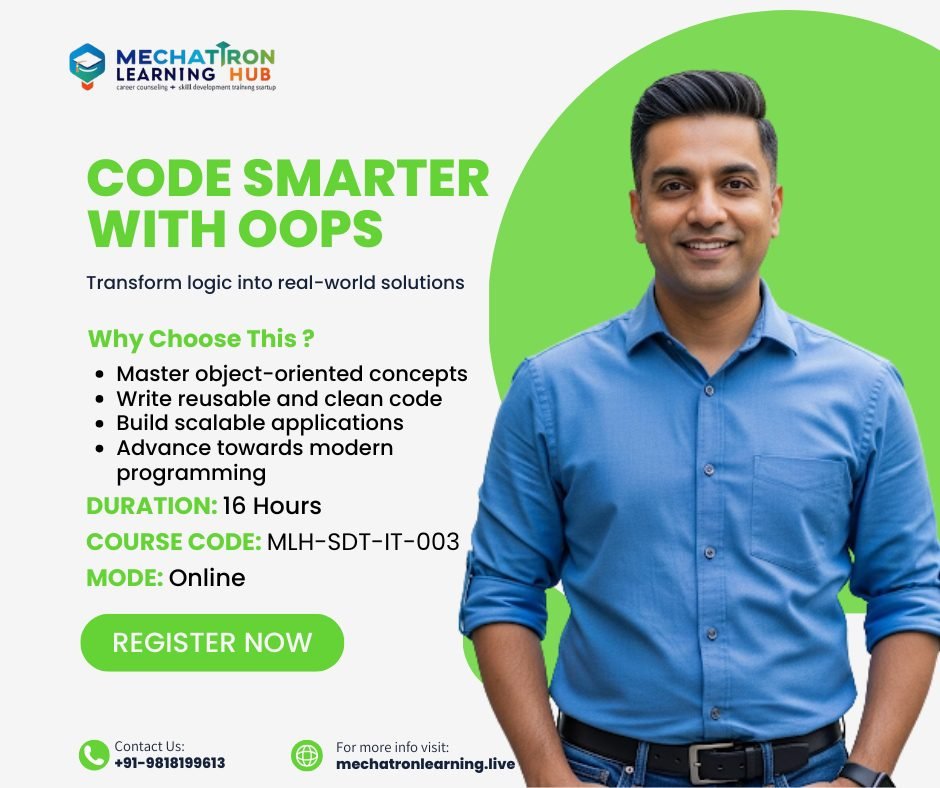
This program introduces learners to Object-Oriented Programming (OOP) principles and their practical implementation in a programming language (e.g., Python, Java, or C++). Through hands-on coding exercises and mini-projects, participants will understand classes, objects, inheritance, polymorphism, and encapsulation, and learn to design robust, modular, and reusable code. The course is suitable for students, freshers, working professionals, and educators looking to strengthen programming fundamentals and software development skills.


Learning Objectives

By the end of this program, learners will be able to:

  • Understand the fundamental concepts of OOP: classes, objects, methods, attributes.
  • Apply inheritance, polymorphism, encapsulation, and abstraction in programming.
  • Design modular and reusable code using OOP principles.
  • Implement real-world projects using OOP concepts.
  • Debug and optimize object-oriented code.
  • Apply OOP knowledge in software development, academic projects, and teaching.

Target Audience

  • College Students & Freshers: Build strong programming and software development skills.
  • Working Professionals: Upskill in OOP for software development and automation.
  • Educators: Teach programming concepts using OOP effectively.
Show More

Course Content

Module 1: Introduction to Programming & OOP Concepts
Content to covered: Overview of programming paradigms (procedural vs object-oriented), Key OOP concepts: class, object, method, attribute, Benefits of OOP: modularity, reusability, maintainability, Hands-on: Write a basic class and create objects.

  • Live Class: 1.5 Hours
  • Doubt/Practice: 30 Minutes

Module 2: Classes, Objects & Constructors
Content to be covered: Defining classes and creating objects, Constructors and destructors, Instance variables vs class variables, Instance variables vs class variables.

Module 3: Methods & Encapsulation
Content to be covered: Instance methods vs class methods, Access modifiers: public, private, protected, Encapsulation for data hiding and security, Hands-on: Implement getter and setter methods in a class.

Module 4: Inheritance & Code Reuse
Content to be covered: Single, multiple, and multilevel inheritance, Superclass vs subclass, Method overriding, Hands-on: Create a hierarchy of Employee and Manager classes.

Module 5: Polymorphism & Abstraction
Content to be covered: Method overloading and overriding, Abstract classes and interfaces, Benefits of polymorphism in software design, Hands-on: Implement a shape hierarchy with abstract methods.

Module 6: Collections & OOP
Content to be covered: Using lists, dictionaries, and arrays in OOP, Iterating over object collections, Hands-on: Manage a collection of Student objects with operations like add, delete, and search.

Module 7: Exception Handling & File I/O in OOP
Content to be covered: Exception handling in object-oriented programs, Reading from and writing to files using OOP principles, Hands-on: Create a program that stores and retrieves employee records from a file.

Module 8: Mini Project & Best Practices
Content to be covered: Capstone project: Build a Library Management System or Student Record System using OOP, Code review and optimization, Discussion on best practices, design patterns, and real-world applications, Educator module: Tips for teaching OOP with examples and exercises.

Student Ratings & Reviews

No Review Yet
No Review Yet