Gyroscope Dynamics
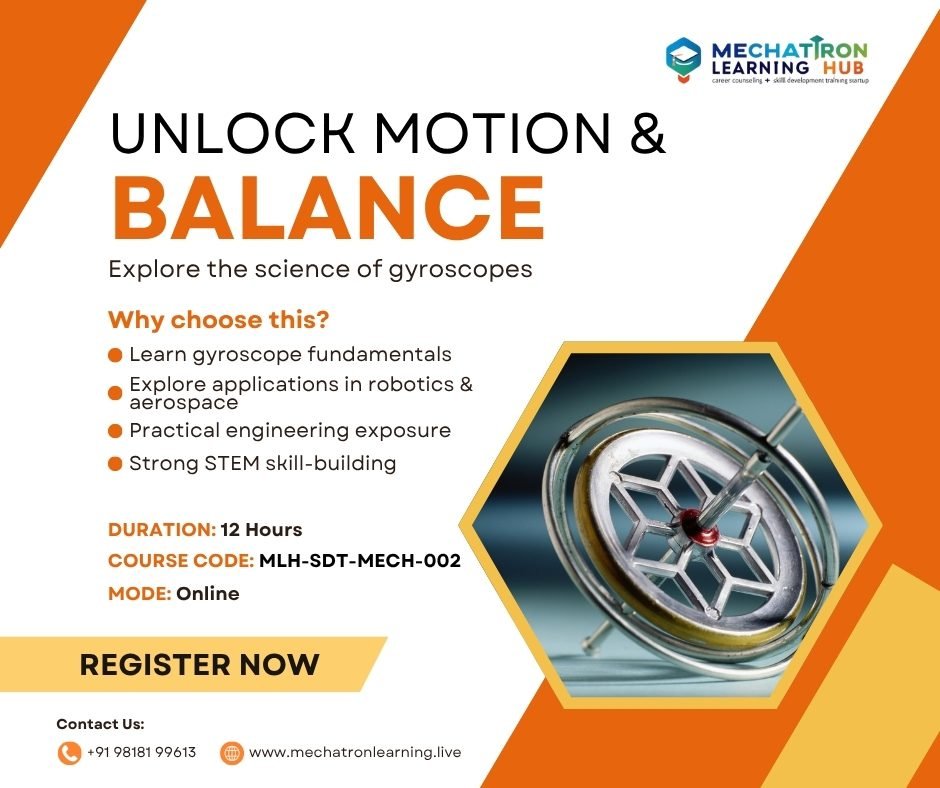
About Course
Course Description
This program introduces learners to the principles of gyroscope dynamics, including rotational motion, angular momentum, precession, and stabilization mechanisms. Participants will explore mechanical and electronic gyroscopes, understand their applications in robotics, aviation, and consumer electronics, and perform practical exercises to reinforce learning. This course is suitable for students, freshers, working professionals, and educators interested in engineering, robotics, and control systems.
Learning Objectives
By the end of this program, learners will be able to:
- Understand the fundamentals of gyroscope motion and rotational dynamics.
- Describe angular momentum, torque, and precession.
- Identify different types of gyroscopes: mechanical, optical, MEMS-based.
- Understand applications in drones, navigation, stabilization, and robotics.
- Perform practical demonstrations and calculations involving gyroscopic motion.
- Apply knowledge in robotics, aerospace, and educational demonstrations.
Target Audience
- College Students & Freshers: Build foundational knowledge for engineering and robotics projects.
- Working Professionals: Upskill for roles in robotics, navigation, aerospace, and automation.
- Educators: Teach gyroscope principles and applications effectively.
Course Content
Module 1: Introduction to Gyroscopes
-
Online Live Class: 1.5 Hours
-
Practice/ Doubt: 30 Minutes
Module 2: Rotational Dynamics & Precession
Module 3: Types of Gyroscopes & Working Principles
Module 4: Gyroscope Applications in Robotics & Drones
Module 5: Calculations, Measurements & Sensor Data
Module 6: Capstone Project & Real-World Applications
Student Ratings & Reviews

No Review Yet