Object-Oriented Programming (OOP)
About Course
Course Description
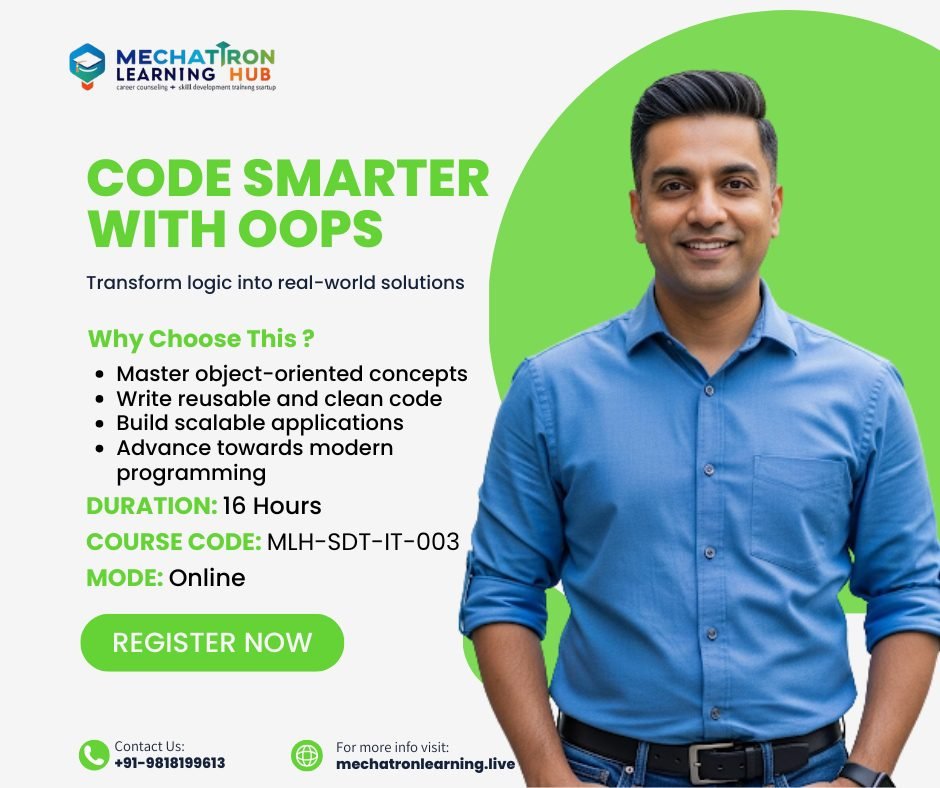
This program introduces learners to Object-Oriented Programming (OOP) principles and their practical implementation in a programming language (e.g., Python, Java, or C++). Through hands-on coding exercises and mini-projects, participants will understand classes, objects, inheritance, polymorphism, and encapsulation, and learn to design robust, modular, and reusable code. The course is suitable for students, freshers, working professionals, and educators looking to strengthen programming fundamentals and software development skills.
Learning Objectives
By the end of this program, learners will be able to:
- Understand the fundamental concepts of OOP: classes, objects, methods, attributes.
- Apply inheritance, polymorphism, encapsulation, and abstraction in programming.
- Design modular and reusable code using OOP principles.
- Implement real-world projects using OOP concepts.
- Debug and optimize object-oriented code.
- Apply OOP knowledge in software development, academic projects, and teaching.
Target Audience
- College Students & Freshers: Build strong programming and software development skills.
- Working Professionals: Upskill in OOP for software development and automation.
- Educators: Teach programming concepts using OOP effectively.
Course Content
Module 1: Introduction to Programming & OOP Concepts
-
Live Class: 1.5 Hours
-
Doubt/Practice: 30 Minutes
Module 2: Classes, Objects & Constructors
Module 3: Methods & Encapsulation
Module 4: Inheritance & Code Reuse
Module 5: Polymorphism & Abstraction
Module 6: Collections & OOP
Module 7: Exception Handling & File I/O in OOP
Module 8: Mini Project & Best Practices
Student Ratings & Reviews

No Review Yet